 Decibels
Measure noise the way acousticians do.
Decibels turns your phone into a sound level meter you can calibrate. It reads the raw microphone, shows A-weighted levels, peaks and LAeq, works out NIOSH and OSHA noise dose, and exports every second to CSV.
Free · No ads · No account · Audio is never recorded · Android 7.0+
- LAF / LAS
- LAeq
- LAFmax / min
- LCpeak
- LZeq
- LA10 · LA50 · LA90
- NIOSH dose
- OSHA dose
- LEX,8h
- TWA
Built for measurement, not for calls
Most meter apps hear what your phone wants them to hear.
Phones clean up the microphone for voice calls. Automatic gain control turns loud sounds down and noise suppression removes steady noise. That helps on a call, but it ruins a measurement. Decibels turns all of it off.
Processed voice input
Loud passages are squashed by gain control, and steady hum is filtered out. The display looks calm when the room isn't.
Raw, unprocessed capture
32-bit float audio straight from the built-in mic, with gain control, noise suppression and echo cancellation switched off.
UNPROCESSED audio source where the phone supports it, and falls back to the calibrated voice-recognition path.Everything a survey needs
One screen. Every number that matters.
The quantities you'd expect from a handheld meter, worked out live from the start of the session.
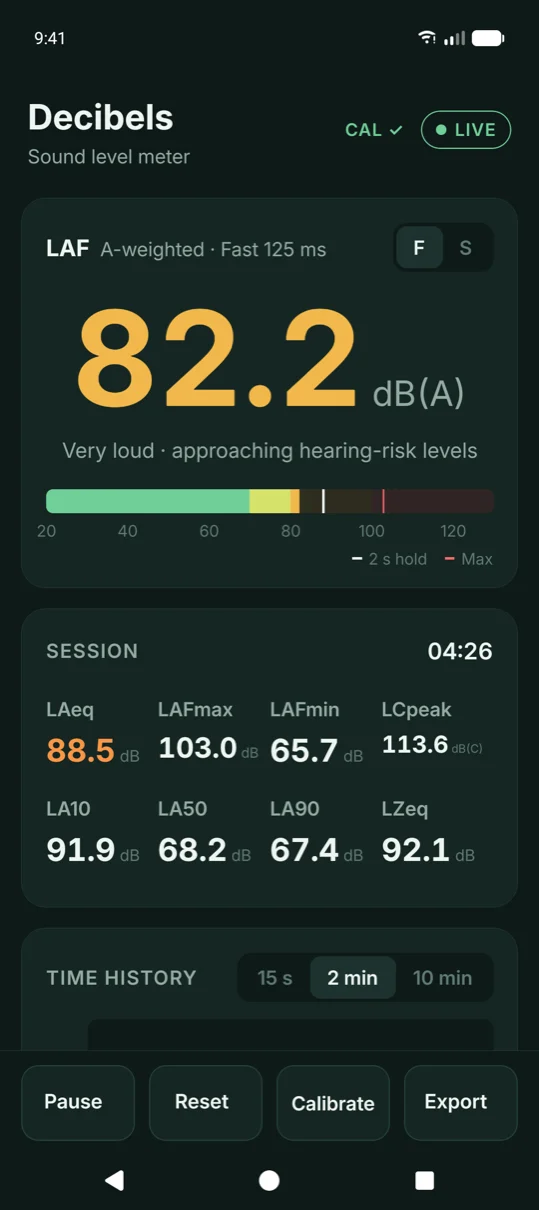
A live meter you can read from across the room
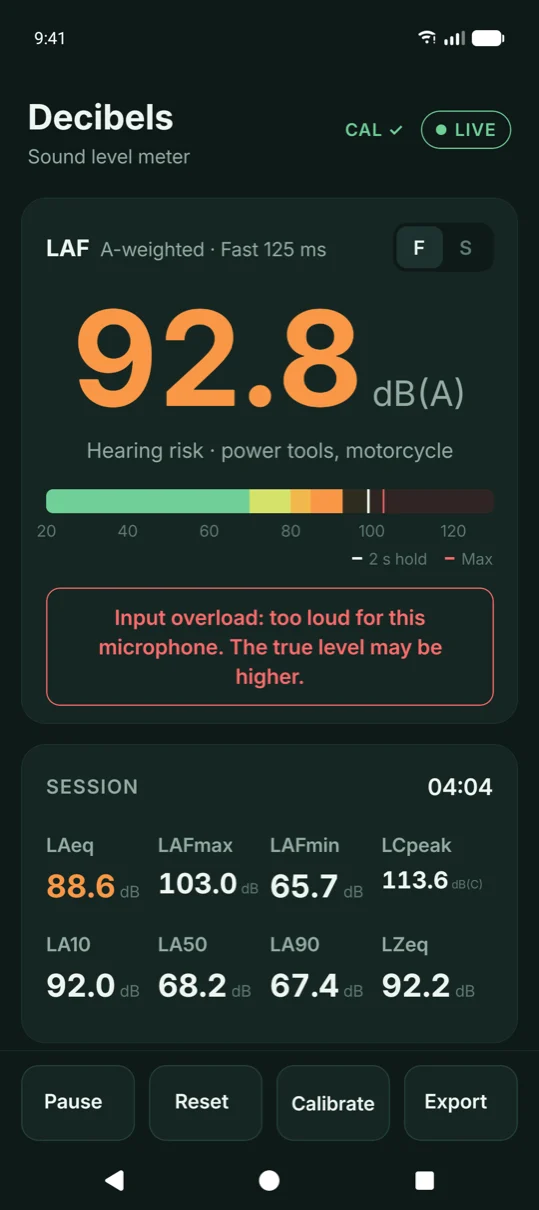
A large A-weighted readout that changes colour with the level, a level bar with a 2-second peak hold and a session maximum marker, and a plain-English guide to what the number means.
- Switch between Fast (125 ms) and Slow (1 s) time weighting
- LAeq, LAFmax/min, LASmax/min, LCpeak and LZeq
- Statistical levels LA10, LA50 and LA90 for background and intrusive noise
See exactly when it got loud
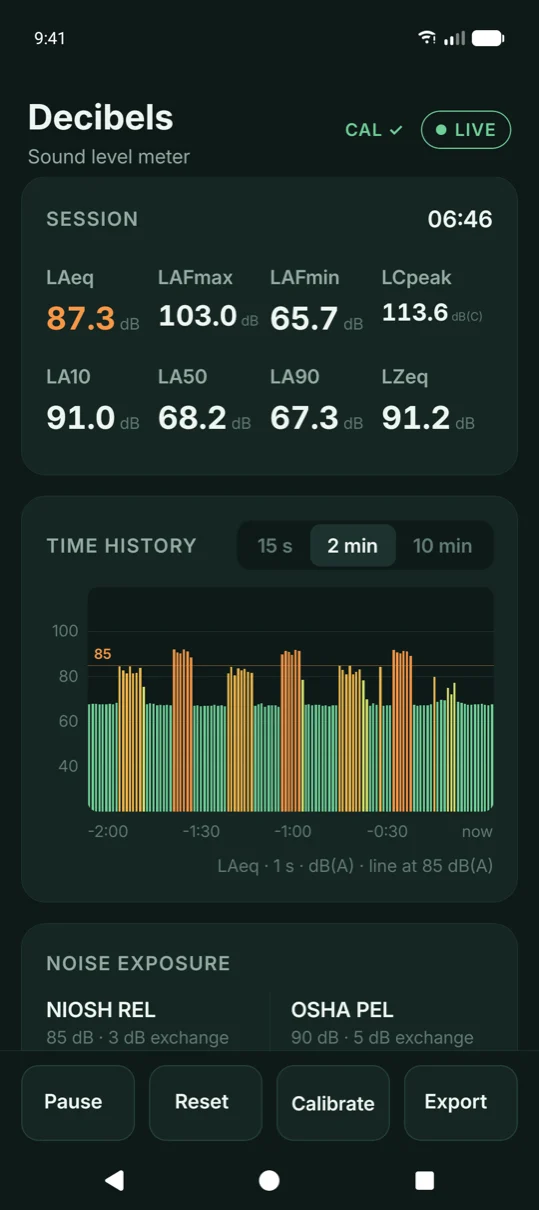
The time history plots LAeq for every second, coloured by level, against an 85 dB(A) line. You can tell at a glance whether a high average came from a steady drone or a few loud bursts.
- 15-second, 2-minute and 10-minute views
- 85 dB(A) line: the NIOSH limit and the EU upper exposure action value
- Up to 24 hours of one-second data kept for export
Noise dose against NIOSH and OSHA, side by side
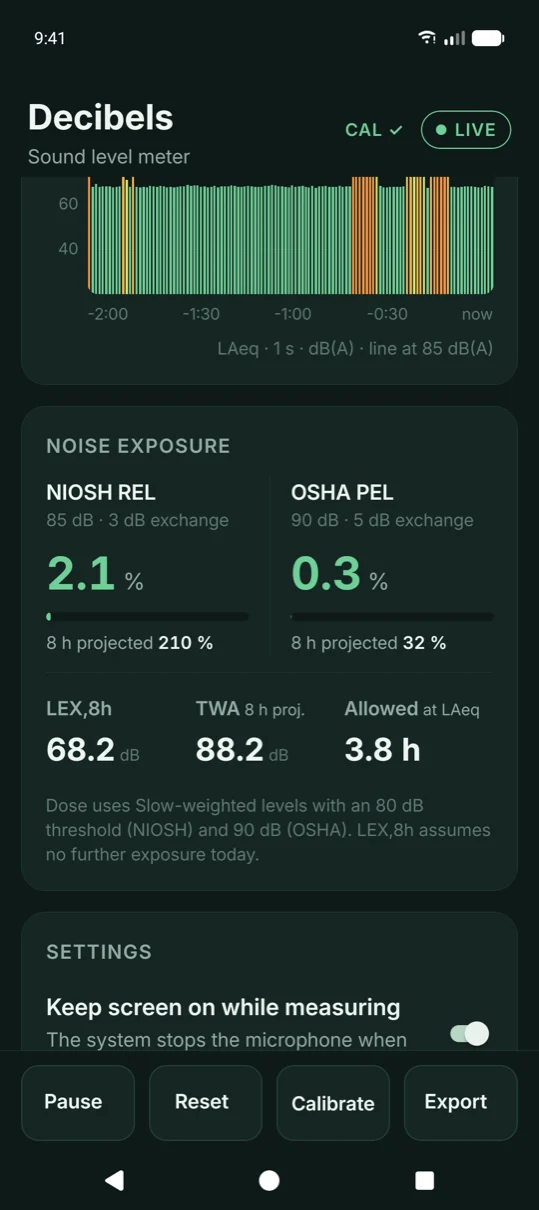
Decibels works out occupational noise dose live from Slow-weighted levels, so you can see how close a shift is to the limit long before it ends.
- NIOSH REL: 85 dB criterion, 3 dB exchange rate, 80 dB threshold
- OSHA PEL: 90 dB criterion, 5 dB exchange rate, 90 dB threshold
- Dose so far, 8-hour projected dose, TWA and LEX,8h
- "Allowed time" at the current LAeq
Calibrate it like a real instrument
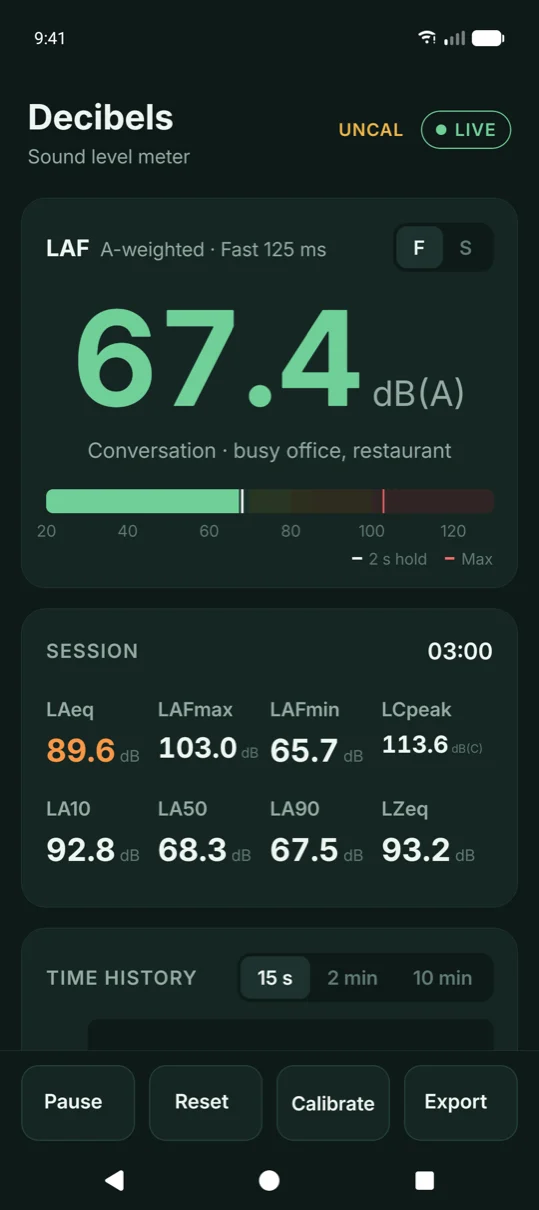
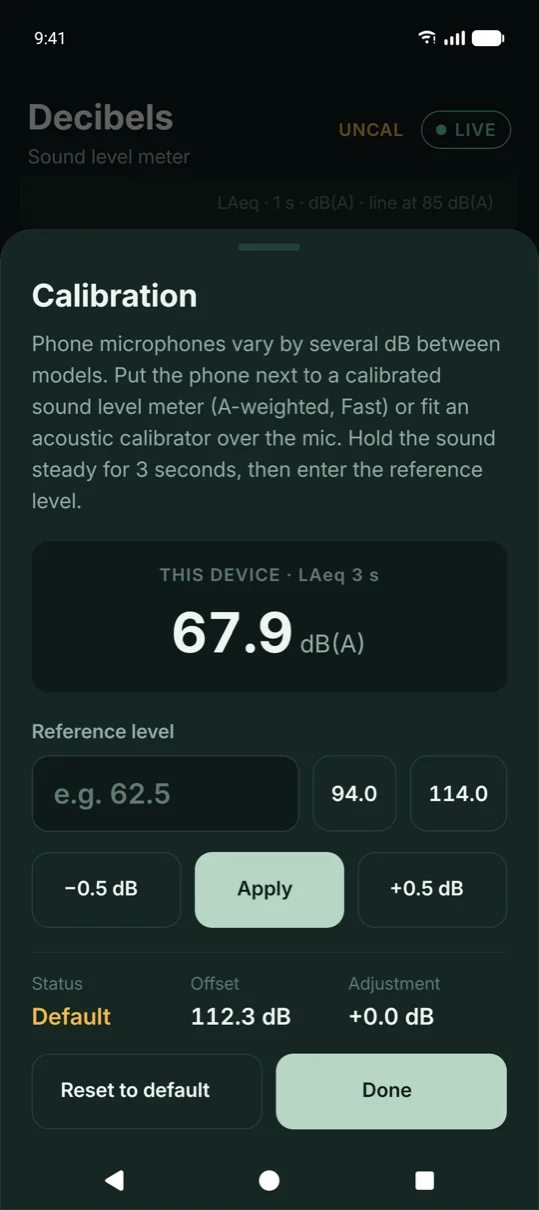
Place the phone next to a calibrated sound level meter, or fit a 94 dB or 114 dB acoustic calibrator over the mic. Hold for three seconds and enter the reference. The offset is saved for that device.
- One-tap presets for 94.0 and 114.0 dB calibrators
- Fine-tune in ±0.5 dB steps
- A new calibration corrects the whole current session, not just new readings
CAL ✓/UNCALbadge so you always know where you stand
Tells you when not to trust it
A good instrument warns you when it's out of range. Decibels does the same.
- Overload warning when sound is too loud for the phone's mic, so the real level may be higher
- No-signal detection when the mic is muted, blocked by a privacy toggle or taken by a call, and silence is never logged as a quiet room
- Reconnects to the microphone on its own after calls and interruptions
- Option to keep the screen on, so long measurements aren't cut short by auto-lock
Who uses it
For anyone who needs a number they can defend.
Health & safety
Screen workshops, plant rooms and job sites. Spot who needs a full noise survey and hearing protection before you bring out the dosimeter.
Live sound & venues
Keep an eye on LAeq and LCpeak at front of house, check a venue's limit across a whole set, and send the CSV to the promoter.
Facilities & property
Record HVAC, generators and neighbour noise with timestamps and statistical levels. LA90 shows the background, LA10 the intrusive sounds.
Acoustic consultants
A calibrated second opinion in your pocket for quick checks, walk-throughs and showing clients what's going on.
Schools & offices
Check classrooms, open-plan offices and canteens against comfort guidelines, and show the effect of a change with real numbers.
Your own hearing
Gigs, gyms, commutes, power tools. See how fast a loud day uses up your safe daily dose.
Reports & data
Leave the site with evidence, not a screenshot.
Share a readable summary straight to email, chat or notes, or export the raw time series and analyse it any way you like.
- Summary report: start time, duration, device, input and calibration status, every level metric, noise dose, plus a per-minute log
- CSV data: one calibrated row per second, ready for Excel, Google Sheets, Numbers, pandas or R
- Up to 24 hours per session
- Files go only where you send them, through Android's share sheet
SOUND LEVEL MEASUREMENT

Start             2026-11-24 09:00:00
Duration          1:00:00
Calibration       user calibrated

LEVELS
LAeq              86.4 dB(A)
LAFmax / min      103.0 / 65.7 dB(A)
LCpeak            113.6 dB(C)
LA10 / 50 / 90    91.0 / 84.2 / 67.3 dB(A)

NOISE EXPOSURE
LEX,8h            77.4 dB(A)
NIOSH dose        17 % (8 h projected 138 %)
OSHA PEL dose     7.6 % (8 h projected 61 %)
…per-minute log follows
Date,Time,Elapsed (s),LAeq dB(A),LAFmax dB(A),LASmax dB(A),LCpeak dB(C),LZeq dB
2026-11-24,09:00:01,1,84.1,86.9,85.0,101.2,88.3
2026-11-24,09:00:02,2,91.7,95.4,92.8,109.6,94.0
2026-11-24,09:00:03,3,88.0,90.2,89.9,104.1,90.7
…
Example values for illustration.
Private by design
It listens. It never records.
Sound is turned into numbers in memory on your phone, as it happens. There's nothing to upload and nothing to sign up for.
Specifications
The technical details.
| Frequency weighting | A (levels and dose), C (peak), Z (unweighted LZeq) |
|---|---|
| Time weighting | Fast 125 ms, Slow 1 s |
| Metrics | LAF, LAS, LAeq, LAFmax, LAFmin, LASmax, LASmin, LCpeak, LZeq, LA10, LA50, LA90 |
| Noise dose | NIOSH REL (85 dB / 3 dB / 80 dB threshold) and OSHA PEL (90 dB / 5 dB / 90 dB threshold): dose, 8 h projection, TWA, LEX,8h, allowed time |
| Audio input | Built-in microphone, 32-bit float PCM at 48 kHz (44.1 kHz fallback), UNPROCESSED source where supported. AGC, noise suppression and echo cancellation disabled |
| Calibration | Against a reference meter or a 94 / 114 dB acoustic calibrator, ±0.5 dB trim, stored per device |
| History | 15 s, 2 min and 10 min views; up to 24 h of one-second and one-minute records per session |
| Export | Plain-text summary report; CSV with one row per second |
| Requirements | Android 7.0 or later. Asks only for microphone access |
We've worked hard to make Decibels as realistic as a phone allows, but accuracy ultimately depends on your device's microphone and software, how you measure, and any calibration you enter. We can't know or control any of these. Decibels is not an IEC 61672 sound level meter, a dosimeter or a medical device. Its readings are estimates for indication and screening only, not for legal compliance, evidence or safety-critical decisions. The app is provided free and "as is". Read the full disclaimer and Terms of Use.
FAQ
Questions, answered.
How accurate is a phone sound level meter?
Out of the box, Decibels uses the microphone sensitivity that Android's compatibility requirements set for compliant devices, and it bypasses the gain control and noise suppression that make most meter apps unreliable. Phones still vary by a few dB, so for dependable readings calibrate once against a calibrated sound level meter or an acoustic calibrator. A phone is not an IEC 61672 Class 1 or Class 2 instrument, so use it for screening and indication rather than legal compliance.
Does Decibels record or upload my audio?
No. Audio is analysed in memory on your phone and turned into sound levels in real time. It is never recorded, saved or sent anywhere. The microphone is only used while the app is open on screen.
What's the difference between LAF, LAS and LAeq?
LAF is the A-weighted level with the Fast (125 ms) time constant, so it follows sound quickly. LAS uses the Slow (1 s) constant and is steadier. LAeq is the equivalent continuous level: the energy average over the whole session. Most noise limits and dose calculations are based on LAeq.
How does the noise dose work?
Decibels works out the dose against two occupational criteria at once: NIOSH REL (85 dB, 3 dB exchange rate) and OSHA PEL (90 dB, 5 dB exchange rate). It shows the dose so far, the dose projected over an 8-hour day, the time-weighted average, LEX,8h, and how long you could stay at the current level. 100 % is the full daily allowance.
Why does measuring stop when I lock the phone?
Android doesn't let apps use the microphone in the background without a persistent notification, and Decibels only listens while it's on screen. Turn on "Keep screen on while measuring" in Settings for long sessions. Measuring starts again automatically when you come back.
What does the overload warning mean?
The sound is louder than the phone's microphone can capture cleanly. The true level may be higher than shown. Very loud sources such as gunfire, engines up close and fireworks are beyond what most phone mics can measure.
Can I export measurements?
Yes. Share a plain-text report with every key metric, the noise dose and a per-minute log, or export a CSV with one row per second (LAeq, LAFmax, LASmax, LCpeak and LZeq) that opens in Excel, Google Sheets, Numbers or Python.
Is Decibels free?
Yes. Decibels is free, with no ads, no in-app purchases and no subscription.
Can I use the readings for legal or workplace compliance?
No. Readings depend on your phone's hardware and software and on your calibration, so they are estimates for indication and screening. Compliance measurements, evidence and hearing-protection decisions need a certified instrument and a qualified professional. See the measurement disclaimer.
Is there an iPhone version?
Decibels is currently available for Android on Google Play.
Put a calibrated sound level meter in your pocket.
Raw-microphone metering, noise dose and CSV export. Free, with no ads and no account.